
By Sam Callander, Meadmaker at Undisturbed Meadery
Mānuka honey is one of New Zealand's most famous natural products. Prized around the world, it has built an extraordinary reputation for its distinctive properties, rarity and value. But there's another side to Mānuka honey that receives far less attention: its flavour.
At Undisturbed Meadery, we turn Mānuka honey into wine - i.e. mead. Through teh natural process of fermentation, we transform the sugars in the honey into alcohol, revealing an extraordinary range of flavours, from warm spices and vanilla to earthy, woody and floral notes.
We've now developed four different Mānuka meads, each exploring the possibilities of this remarkable Aotearoa ingredient. From our everyday Mānuka Mead to our limited-edition Special Reserves, it's become one of the most exciting honeys we work with.
Explore our Mānuka meads:
What makes Mānuka honey so special?
Mānuka (Leptospermum scoparium) is a flowering shrub or small tree found throughout New Zealand. It's a hardy pioneer species, often among the first plants to establish themselves on disturbed land, hillsides and regenerating landscapes.
Its flowers are small, generally white and sometimes pink, with five petals surrounding a cluster of stamens. Individually they're quite delicate, but when large areas of Mānuka flower together, the landscape can become covered in blossom.
For beekeepers, this flowering is an important annual opportunity. Mānuka produces nectar over a relatively short seasonal window, and the amount available to bees depends on local conditions, including temperature, rainfall and wind.
A successful harvest requires healthy bee colonies, good hive placement, suitable weather and enough flowering Mānuka within foraging distance.
Unlike a crop that can simply be harvested on a fixed date, honey production depends on a remarkable partnership between plants, bees, beekeepers and the weather.
The result is one of New Zealand's most distinctive honeys.
For more about Mānuka honey production, see Midlands' Mānuka honey information, and Mount Somers Honey's account of Mānuka honey production and quality assurance.
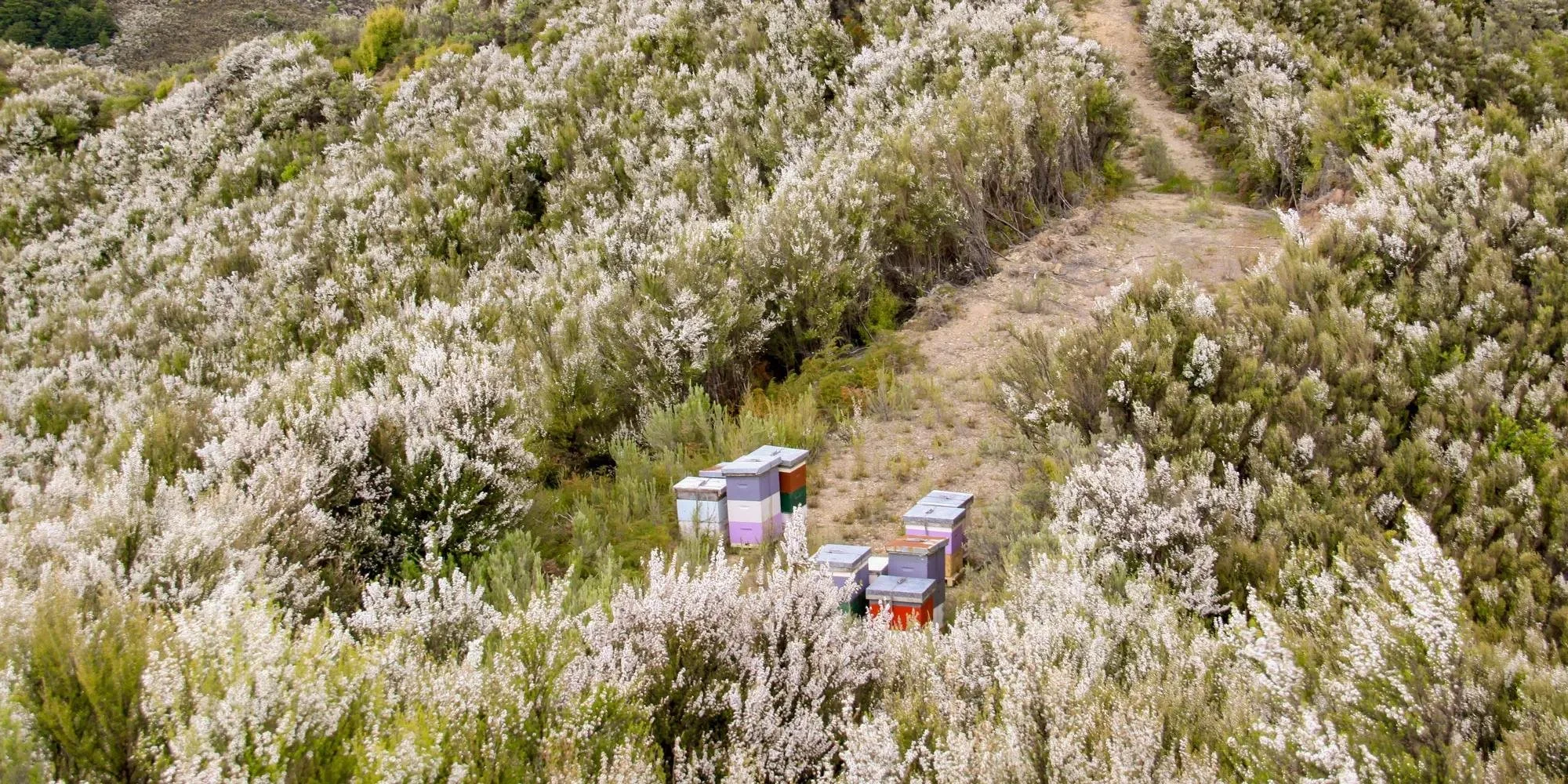
Beehives on in a Mānuka forest
What is monofloral Mānuka honey?
Not all honey labelled Mānuka is the same.
Bees may visit a variety of flowering plants during a foraging trip. Even where Mānuka dominates the landscape, other nectar sources may contribute to the finished honey.
In New Zealand, honey sold for export as Mānuka must meet a scientific definition established by the Ministry for Primary Industries (MPI). This uses laboratory testing for specific chemical markers and a DNA marker associated with Mānuka pollen.
The tests distinguish between two categories:
Monofloral Mānuka honey, which meets the higher thresholds in the official definition.
Multifloral Mānuka honey, which meets a different set of thresholds indicating Mānuka contribution alongside other floral sources.
Monofloral doesn't mean that every bee visited only Mānuka flowers. It means the honey meets the scientifically defined criteria for that classification.
These distinctions matter for honey producers, consumers and meadmakers alike.
At Undisturbed, our everyday Mānuka Mead and our Special Reserve meads explore different expressions of Mānuka honey. Our Special Reserve programme uses monofloral honey, allowing us to investigate the character of this celebrated ingredient in a particularly concentrated form.
You can learn more about the official definition through New Zealand's Ministry for Primary Industries.
What do UMF and MGO mean?
If you've ever bought a jar of premium Mānuka honey, you've probably noticed numbers such as UMF 5+, UMF 10+ or MGO 263.
These relate to the chemical composition and grading of the honey.
MGO stands for methylglyoxal, a naturally occurring compound associated with Mānuka honey's distinctive antibacterial activity. MGO concentration is measured in milligrams per kilogram of honey.
UMF, or Unique Mānuka Factor, is a broader certification and grading system that considers several markers associated with authenticity and quality, including MGO.
For example, Midlands lists Mānuka honey grades ranging from UMF 5+ (MGO 83) through to UMF 31+ (MGO 1722).
Higher grades generally command higher prices, reflecting their measured properties, supply and market demand.
For a meadmaker, however, there's an interesting distinction.
The highest UMF grade doesn't necessarily produce the best-tasting mead.
UMF grading tells us something important about the honey's composition and authenticity. It isn't a sensory score for how delicious the honey will become after fermentation.
We're interested in the flavour, aroma, balance and character of the finished wine. These depend on the original honey, but also on the fermentation, yeast, residual sweetness, maturation and other decisions made in the meadery.
That's what makes Mānuka such an interesting ingredient to explore.
Read more about the UMF grading system and Mānuka honey supply at Midlands.
What does Mānuka honey taste like?
Mānuka honey has a character quite unlike many of the lighter honeys produced from pasture flowers.
Depending on its origin and composition, it can have a rich, earthy, herbal quality, with woody, aromatic and sometimes slightly bitter notes alongside its sweetness.
The flavour can be remarkably persistent.
It's this complexity that first drew us to experimenting with Mānuka honey at Undisturbed.
When we made our first Mānuka mead, we were blown away by the strength of the flavours. We discovered layers of flavour that we hadn't experienced in other honeys, and began to appreciate just how much potential Mānuka had as a winemaking ingredient.
Our finished mead can show vanilla, warm spices, subtle woodiness and a deep, lingering richness. There's a weight to it that can be reminiscent of port, with a character that continues to unfold as you sip.
And the remarkable thing is that these flavours can emerge without adding fruit or spices.
They begin with the honey itself.
What happens when Mānuka honey is fermented?
Mead is made by fermenting honey with water. Yeast consumes fermentable sugars and produces alcohol, carbon dioxide and a range of compounds that influence aroma and flavour.
At Undisturbed, our approach to traditional mead is deliberately simple: water, honey, yeast and time. Fermentation is a significant transformation.
Honey is naturally concentrated in sugars. In its original form, sweetness dominates much of the tasting experience. Diluting and fermenting the honey changes that balance, allowing other characteristics to become more apparent.
As fermentation progresses, the amount of sugar remaining decreases. The yeast also creates new aroma and flavour compounds, while the developing alcohol changes how we perceive the finished drink.
Some honey-derived characteristics survive fermentation, others change, and some may become less noticeable. The resulting mead can therefore taste surprisingly different from the honey that went into it.
With Mānuka, we find this particularly exciting. The honey's richness, aromatic complexity and distinctive character provide an extraordinary foundation for fermentation.
The choices we make as meadmakers — from the honey selected to the final sweetness and maturation — influence how that character is expressed.
There's also an important distinction worth making: fermenting Mānuka honey into an alcoholic beverage does not mean the finished mead retains the medicinal properties associated with particular grades of honey. We make Mānuka mead for its flavour and drinking experience. We’ve tried, without success, to find a lab that can test our meads for the active ingredients in Mānuka honey - so Mānuka mead’s quality in this sense remains unknown. We do know that there are no detectible toxic metals in the mead, which is pretty cool.
Four ways we're exploring Mānuka honey
One of the joys of working with Mānuka is discovering how differently it can express itself.
We've now developed four Mānuka meads, from a versatile everyday bottle to limited-edition vintages intended for special occasions.
1. Undisturbed Mānuka Mead — our original expression
Our Mānuka Mead is where the journey began.
Made from New Zealand Mānuka honey and fermented to 13% alcohol, it has become one of the foundations of our range.
Rich, layered and full of character, it offers notes of vanilla, warm spices, subtle woodiness and the unmistakable richness of Mānuka.
We enjoy it slightly chilled, at room temperature, or even over a little ice. It pairs beautifully with aged cheese and dark chocolate.
For someone wanting to discover what Mānuka honey can become through fermentation, this is a wonderful place to start.
2. Mulled Mānuka Mead — a winter expression
Our Mulled Mānuka Winter Mead takes the richness of Mānuka in another direction.
Inspired by the long tradition of warming wine or mead with spices, we combine Mānuka mead with cinnamon, cloves and star anise.
The spices complement the honey's natural richness, creating a drink made for cold evenings, gatherings with friends and the Matariki season.
It's designed to be heated gently and enjoyed from a mug, without boiling.
This seasonal release has shown us how well Mānuka's natural flavour works alongside traditional warming spices.
3. 2025 Mānuka Special Reserve — our first collectors' edition
Our 2025 Mānuka Special Reserve was an opportunity to take our exploration of Mānuka to another level.
Made using premium monofloral Mānuka honey, this limited-edition mead was fermented to 16.4% alcohol and gently aged to develop its complexity.
Only 50 bottles were allocated for public sale, each accompanied by a signed certificate of authenticity.
The resulting mead is rich, smooth and complex, with warm spice, woodiness and a long finish.
At the 2026 Mead Madness Cup, it received an overall score of 89/100. The judges described aromas of chocolate, coffee, fennel and herbs, alongside flavours of spice, smoke and remarkable complexity.
It's a mead to savour slowly, perhaps after dinner, with good company and no particular hurry.
4. 2026 Mānuka Special Reserve — exploring oak and maturation
For our 2026 Special Reserve, we continued exploring the potential of monofloral Mānuka honey, this time incorporating French oak into the maturation.
Oak can contribute additional aromatic complexity, including vanilla, spice and woody notes, while changing the balance and texture of the finished wine.
The result attracted the attention of Master Sommelier Cameron Douglas, who awarded our 2026 Mānuka Special Reserve 95/100 — Outstanding.
His tasting notes identified Mānuka honey, wood smoke, oak spices, peach, nectarine, wildflowers, honeysuckle and vanilla, alongside a persistent finish.
For us, this recognition was particularly meaningful. It demonstrated that a wine made from New Zealand honey could be evaluated alongside other fine wines on the strength of its flavour, balance and craftsmanship.
You can read the full Master Sommelier review here, or explore our mead store for the current Special Reserve release.
Is Mānuka mead sweet?
It can be, but the sweetness of a finished mead is a choice made during production.
Mānuka honey starts out naturally sweet, but fermentation converts much of its sugar into alcohol. A mead can be made dry, semi-dry or sweet depending on the fermentation process and how the finished wine is balanced.
Our Mānuka range generally celebrates the honey's natural richness, with enough sweetness to complement its deeper aromatic character.
However, sweetness is only one part of the drinking experience. Acidity, alcohol, aroma, texture and the honey's natural flavour all influence how sweet or rich a mead seems.
A well-balanced mead can be rich and satisfying without feeling overly sugary.
How should you drink Mānuka mead?
There are no complicated rules, but temperature and glassware can make a real difference.
Our everyday Mānuka Mead is lovely slightly chilled, particularly in warmer weather. At room temperature, more of its aromatic character can become apparent.
Our Special Reserve meads are particularly enjoyable in smaller pours, served in a good wine glass and given time to open up.
For something different, try a little Mānuka mead over a large ice cube, much as you might enjoy a whisky.
Food pairings are another pleasure. We particularly enjoy Mānuka mead alongside aged cheeses, dark chocolate and rich desserts. The honey's warm, earthy character can complement savoury and sweet flavours alike.
And when winter arrives, Mulled Mānuka is made for gentle warming and sharing.
From the Mānuka flower to the glass
What excites us most about Mānuka mead is the connection it creates between the landscape and the finished drink.
It begins with a flowering plant growing across Aotearoa, continues through the work of bees and beekeepers, and eventually arrives at our meadery as a remarkable ingredient.
From there, fermentation and maturation allow us to explore its character in ways that are still relatively unfamiliar to most wine drinkers.
Mānuka honey has already earned an international reputation. We believe its potential as a winemaking ingredient deserves to be just as widely explored.
And we're only beginning to discover what's possible.
Explore our Mānuka meads:
Made in Christchurch, Aotearoa New Zealand. Water, Honey, Yeast, Time.
Further reading
For anyone curious to explore the science, beekeeping and remarkable story of Mānuka honey:
Midlands — Mānuka Honey: Honey grades, traceability, certification and commercial supply.
Mount Somers Honey — Midlands Apiaries and New Zealand Mānuka Honey: An insight into Mānuka honey production, laboratory testing and the work of beekeepers.
Undisturbed — Why Monofloral Mānuka Honey Is Special: Our earlier exploration of the rarity and character of monofloral honey.
Undisturbed — Our Approach to Mead: How we explore the flavours of Aotearoa through honey fermentation.
